Working Model 2d Crack- Today

SQL Database Recovery software is a reliable solution to Fix suspect SQL databases

Rated (4.9 out of 5) by 998 Customers

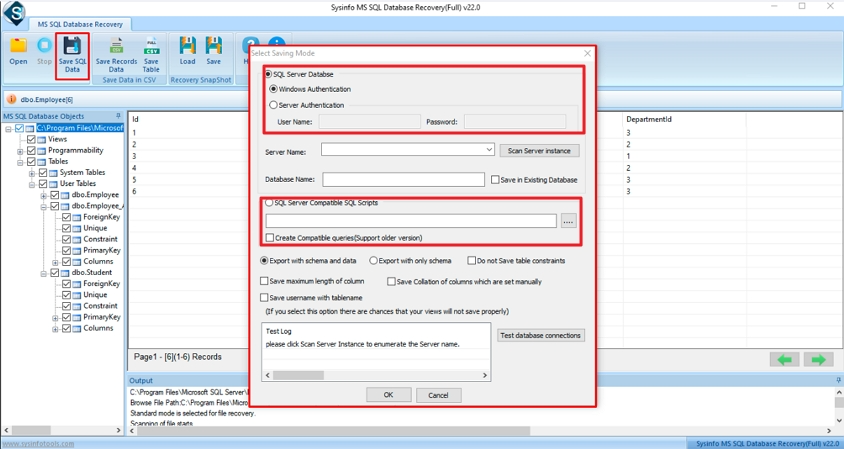
Corruption can lead to inaccessibility on the database files, and they are tagged as suspect. To repair SQL database files, a reliable recovery solution is mainly needed. This recovery software can perform SQL Server recovery with utmost accuracy and restore SQL database contents. Also, it supports recovery from NDF file, a secondary database file of SQL Server. Moreover, all the recovered data can be saved into an MS SQL database file or in the form of SQL Script.

Free Download   Purchase Now
  • Dual recovery modes for different levels of corruption.
  • Recovery of tables, views, store procedures, triggers, etc.
  • Preview of recovered data is enabled before saving them.
  • Ability to restore database in SQL Server using query.
  • Supports SQL Server ROW-compression & PAGE-compression.
  • Reliable SQL recovery software supports NDF files too.
  • Saving recovered data into a SQL database or SQL script.
  • Export either schema only or both data corrupt MDF file.
  • Handle Errors like SQL Server Database not accessible.
  • Supports SQL Server 2005, 2008, 2012, and 2014.

[ \Delta W = \int_\Gamma_N \mathbft\cdot \Delta\mathbfu,\mathrmdS . \tag7 ]

Figure 1 : Load‑displacement response (phase‑field vs. LEFM). Figure 2 : Phase‑field contour at (F = 0.9F_c) (crack tip radius ≈ 3(\ell)). A DCB specimen (length 0.2 m, thickness 0.01 m) is subjected to a symmetric opening displacement. The energy release rate calculated from the phase‑field solution

The arc‑length parameter is updated each load step, ensuring a smooth equilibrium path through post‑peak regimes. | Component | Tool / Library | |-----------|----------------| | FEM core | deal.II (v9.5) | | Linear solver | PETSc (GMRES + ILU) | | Non‑linear solver | Newton‑Raphson with line‑search | | Mesh adaptivity | p4est (parallel refinement) | | Post‑processing | ParaView (VTK output) |

[ \mathbfu^h(\mathbfx) = \sum_i=1^N_n \mathbfN_i(\mathbfx) , \mathbfu i, \qquad \phi^h(\mathbfx) = \sum i=1^N_n N_i(\mathbfx) , \phi_i, \tag5 ]
[ G = \frac{P^2

The phase‑field approach was first introduced by Francfort & Marigo (1998) and later regularised by Bourdin, Francfort & Marigo (2000). Since then, a plethora of works (Miehe et al., 2010; Borden et al., 2012; Wu, 2018) have demonstrated its versatility for quasi‑static, dynamic, and fatigue fracture. However, practical adoption still requires a that guides the user from model formulation to implementation, parameter calibration, and verification.

The first equation is the for a degraded material. The second is a reaction‑diffusion equation governing the evolution of the crack field. Irreversibility is enforced by a history field (H(\mathbfx) = \max_t\le t\psi^+(\boldsymbol\varepsilon(\mathbfx,t))) so that the tensile energy term never decreases:

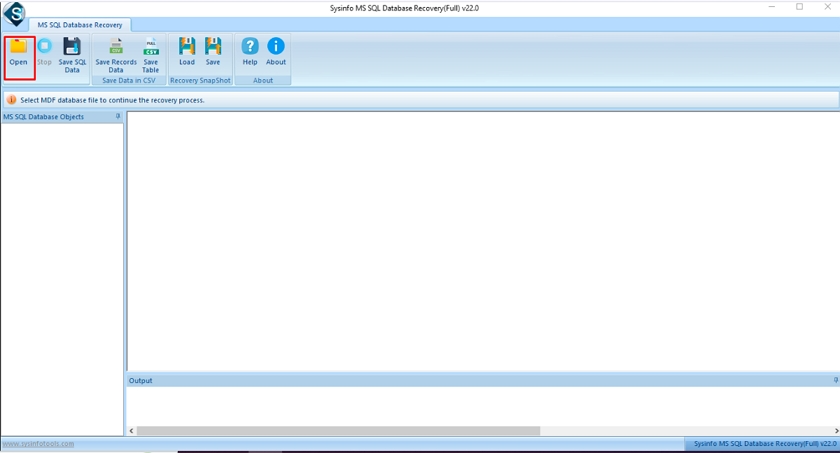
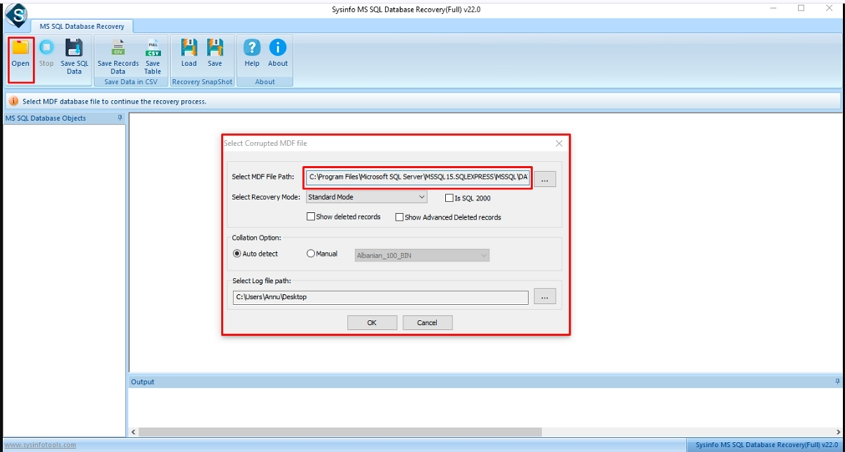
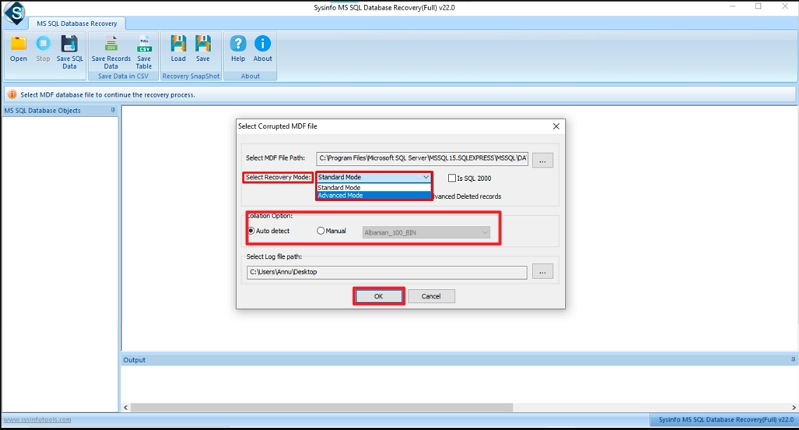
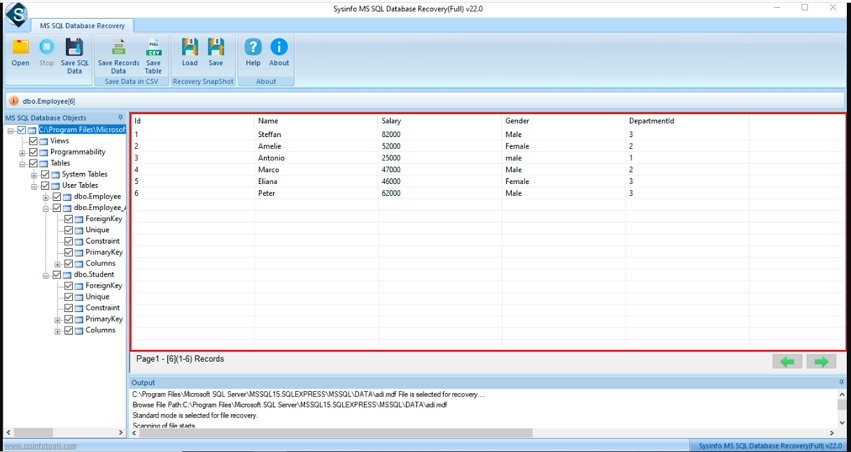
Screenshots

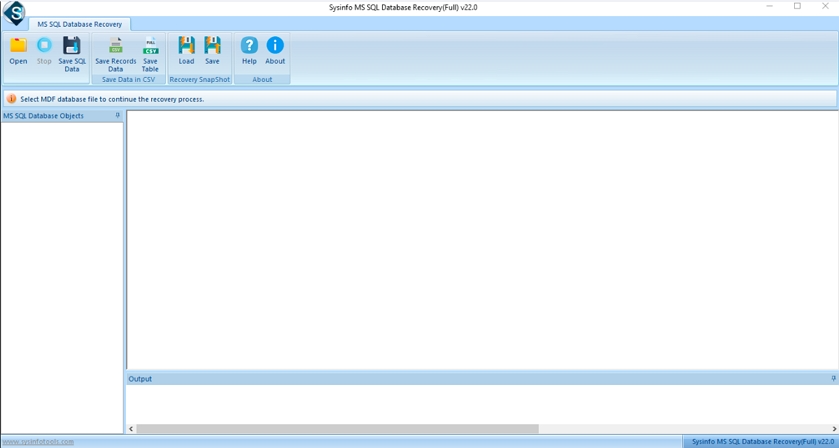
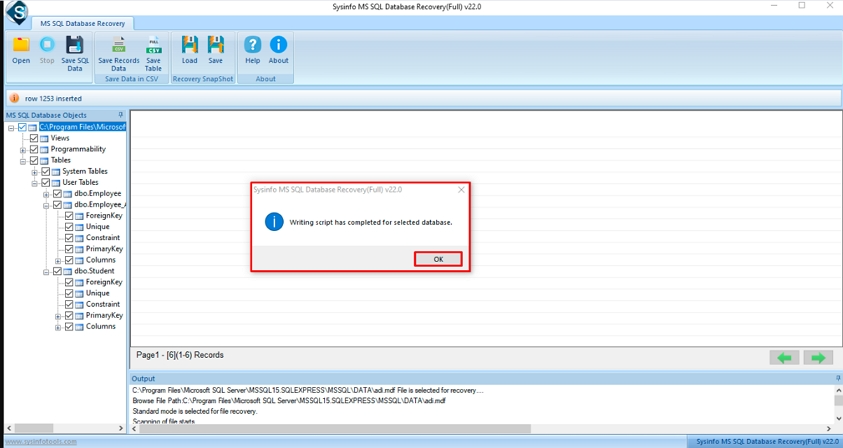
SQL Database Recovery Software- Screenshots

To view full software guide, Click Here

Specs

Software Specifications

Version: 24.08
Size: 1.8 MB
Language: English
Edition: Single, Admin, Technician & Enterprise
Processor: Intel® Core™2 Duo E4600 Processor 2.40GHz
RAM: 8 GB (16 GB Recommended)
Hard Drive: 512 MB
Supported Windows: 11, 10/8.1/8/7/, 2008/2012 (32 & 64 Bit), and other Windows versions.
Trial Limitation: The trial version of the software allows you to only preview and scan the recovered data. To save or export the recovered data, you need to purchase the full version of the tool.
Comparison

Difference Between Free SQL Repair Tool & Full Version

Get an Overview of SQL Database Recovery Tool for Free & Full Version.

Features Available Demo Version Full Version
Repair Files of All SQL Versions
Offer Dual SQL Recovery Mode
SQL ROW-Compression & PAGE Compression
Repair corrupt SQL Database
Save recovered files Only Preview
24*7 Technical Support
Supports All the Windows Version
Download and Purchase Download Purchase

Working Model 2d Crack- Today

[ \Delta W = \int_\Gamma_N \mathbft\cdot \Delta\mathbfu,\mathrmdS . \tag7 ]

Figure 1 : Load‑displacement response (phase‑field vs. LEFM). Figure 2 : Phase‑field contour at (F = 0.9F_c) (crack tip radius ≈ 3(\ell)). A DCB specimen (length 0.2 m, thickness 0.01 m) is subjected to a symmetric opening displacement. The energy release rate calculated from the phase‑field solution

The arc‑length parameter is updated each load step, ensuring a smooth equilibrium path through post‑peak regimes. | Component | Tool / Library | |-----------|----------------| | FEM core | deal.II (v9.5) | | Linear solver | PETSc (GMRES + ILU) | | Non‑linear solver | Newton‑Raphson with line‑search | | Mesh adaptivity | p4est (parallel refinement) | | Post‑processing | ParaView (VTK output) |

[ \mathbfu^h(\mathbfx) = \sum_i=1^N_n \mathbfN_i(\mathbfx) , \mathbfu i, \qquad \phi^h(\mathbfx) = \sum i=1^N_n N_i(\mathbfx) , \phi_i, \tag5 ]

[ G = \frac{P^2

The phase‑field approach was first introduced by Francfort & Marigo (1998) and later regularised by Bourdin, Francfort & Marigo (2000). Since then, a plethora of works (Miehe et al., 2010; Borden et al., 2012; Wu, 2018) have demonstrated its versatility for quasi‑static, dynamic, and fatigue fracture. However, practical adoption still requires a that guides the user from model formulation to implementation, parameter calibration, and verification.

The first equation is the for a degraded material. The second is a reaction‑diffusion equation governing the evolution of the crack field. Irreversibility is enforced by a history field (H(\mathbfx) = \max_t\le t\psi^+(\boldsymbol\varepsilon(\mathbfx,t))) so that the tensile energy term never decreases:

Testimonials

What Client Says about SQL Database Recovery?

Verified Customer Feedback of using this tool.