Eliminador instantáneo de Bg
Borrador de fondo gratuito
Eliminar fondo en línea
Edición de fotos de fondo

Haga clic para cargar
PNG, JPEG, JPG o WEBP (máx. 800×400px)
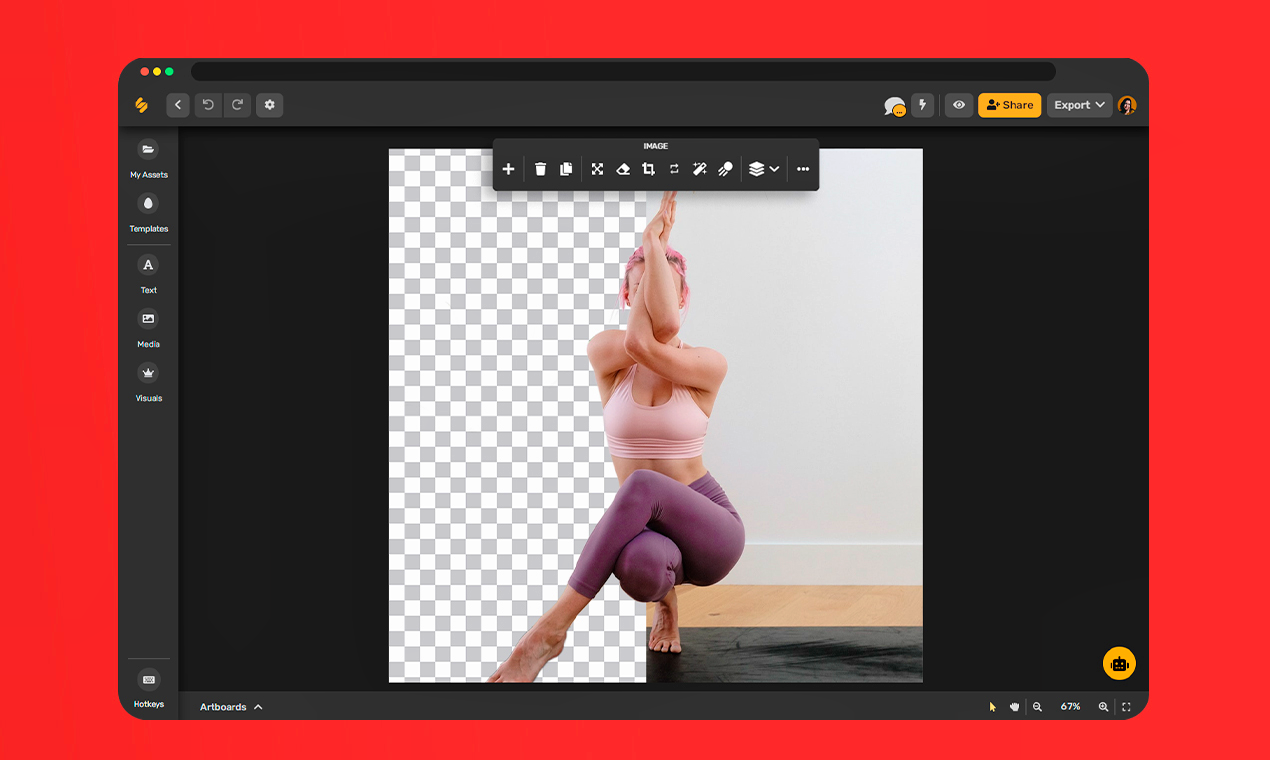
Eliminar los antecedentes de las imágenes censuradas, ocultas, ocupadas, rebeldes, luchas, peleas, valientes. Cargue imágenes en cualquier formato y en un solo clic obtenga una imagen de fondo transparente de alta calidad lista para ser utilizada en todas sus campañas de marketing.

Cree imágenes de calidad profesional para listados de productos, redes sociales, sitios web, boletines, folletos, libros y más con nuestro eliminador de fondo mágico. Agregue un fondo diferente o agregue gráficos y componentes, cambie el tamaño, anime y agregue filtros con nuestro estudio de arte digital gratuito.
Simplified blog is a great place to learn from the best in Instagram marketing. Whether you want to bulk up on social media knowledge or get your first followers.
The appendices are a masterclass in organization. The saturation tables, superheat tables, and compressibility charts are clean, readable, and contain minimal errors. The book also introduces IT (Interactive Thermodynamics) – a now-dated but conceptually important software tool that forces students to think about iteration and property lookup rather than just reading a line.
The Gold Standard for Mechanical Engineering Undergraduates Since its first edition, Moran & Shapiro has established itself as the dominant textbook for engineering thermodynamics. If you are a mechanical or aerospace engineering student in the US, there is a high probability this is (or was) your required text. But does its reputation hold up against modern teaching methods and software tools?
A dense, rigorous, and exceptionally precise reference text. Excellent for deep understanding and problem-solving methodology, but a poor choice for intuitive, conceptual learning or self-study without an instructor. The Good (Why it’s the industry standard) 1. Unmatched Rigor and Precision Moran & Shapiro treats thermodynamics like the serious engineering science it is. The text is meticulous about definitions (closed vs. open systems, intensive vs. extensive properties). It avoids the hand-wavy explanations found in more introductory texts (like Cengel). If you want to know exactly why the sign convention for work is what it is, this book delivers. thermodynamics moran shapiro
While excellent at mathematical formulation, the book is surprisingly weak at building physical intuition . The explanation of entropy, for example, is mathematically correct but physically opaque. Students often finish the chapter able to calculate $\Delta S$ but unable to explain what entropy is in plain English.
This is where the book shines. Chapters 4 and 5 (Control Volume Analysis) present a systematic, step-by-step method for analyzing nozzles, turbines, compressors, and heat exchangers. The "steady-flow energy equation" (SFEE) is broken down with a clarity that few texts match. Students who work through these examples learn a repeatable process, not just equation-memorization. The appendices are a masterclass in organization
The text spends hundreds of pages drilling manual interpolation in steam tables. While this is necessary for understanding, modern engineers use NIST REFPROP or Python libraries. The book’s approach to software (IT) is clunky and proprietary. Later editions have improved this, but the DNA is still table-centric.
Most introductory texts treat exergy as an afterthought. Moran & Shapiro integrates exergy analysis (Chapter 7) as a core topic, correctly positioning it as essential for modern efficiency analysis, sustainability, and system design. The Bad (The barriers to learning) 1. Dense, Dry, and Intimidating Prose Let’s be honest: reading Moran & Shapiro is not enjoyable. The text is written in a formal, passive, almost legalistic tone. Paragraphs are dense with equations and cross-references. It lacks the conversational style and real-world "hook" that Cengel or Borgnakke provide. For a 9 AM class after a late night, this book puts you to sleep. A dense, rigorous, and exceptionally precise reference text
Every example follows a strict Given-Find-Schematic-Assumptions-Analysis-Comment structure. This is invaluable for training young engineers to document their work professionally. The "Comment" section often provides physical insight or warns about common mistakes.