At its core, Blood Waves is a wave-based survival shooter with a minimalist aesthetic. The premise is immediate: you are a lone figure on a dark, fog-shrouded shoreline. From the black water, skeletal enemies emerge in escalating hordes. There is no explanation, no cutscene, no hero’s journey—only the immediate, pressing need to survive the next sixty seconds. The PLAZA release, known for its clean, DRM-free presentation, allows the game’s pure mechanical loop to stand front and center. You have a sword, a bow, and a limited area to maneuver. Each kill yields currency to upgrade weapons, unlock perks, or purchase healing. That is the totality of the system.

Where the game falters—and where a more forgiving title might succeed—is in its unyielding difficulty curve. Blood Waves is brutally fair, but fairness in a wave-based shooter often feels indistinguishable from cruelty. A single mistake in wave eighteen can erase twenty minutes of progress, sending you back to the title screen with nothing but a high score and a bruised ego. The PLAZA version, lacking any online leaderboards or cloud saves, places the onus of meaning entirely on the player. Your reward is not a cosmetic unlock or a story beat, but simply the knowledge that you lasted longer than last time. For players accustomed to extrinsic rewards, this can feel hollow. For those who appreciate intrinsic challenge, it is a breath of fresh air.

However, it would be disingenuous to call Blood Waves a masterpiece. Its depth is an illusion. Once you master the kiting patterns and optimal upgrade paths, the game reveals its limitations. There are only three enemy types and two boss variants. The arena, a circular stretch of sand, never changes. After twenty hours, the hypnotic rhythm can curdle into monotony. The game desperately needs a modifier system, alternative characters with unique abilities, or a “survive the night” endless mode with shifting terrain. As it stands, Blood Waves is a brilliant short story stretched to the length of a novel.

In conclusion, the PLAZA release of Blood Waves is a game of acquired taste. It will repel those seeking narrative, variety, or a gentle learning curve. But for a specific breed of player—the one who finds peace in pattern recognition, satisfaction in optimized loops, and a strange beauty in grim persistence— Blood Waves is a hidden gem. It reminds us that survival is not about building a home or saving a world. Sometimes, survival is just you, a blade, and the endless, crimson tide. And for a little while, that is enough.

In an era where open-world survival games often drown the player in complex crafting trees, sprawling maps, and tutorial pop-ups, Blood Waves —as distributed by PLAZA—offers a stark, almost jarring counterpoint. Stripped of narrative fat and mechanical bloat, this indie title reduces the survival-action genre to its rawest bones: kill, loot, endure, and die. Yet, within this punishing simplicity lies a strangely hypnotic experience. Blood Waves is not a game about grand adventure; it is a game about rhythm, repetition, and the quiet desperation of holding a line.

Aesthetically, the game embraces a low-poly, monochromatic horror that recalls early Limbo or Return of the Obra Dinn . The “blood waves” of the title are literal: as you kill, the tide that laps at your feet turns progressively redder, a visceral barometer of the carnage. The sound design is exemplary—the wet crunch of a skeleton collapsing, the whoosh of a missed arrow, the low, thrumming bass that intensifies as waves progress. The PLAZA release runs flawlessly on modest hardware, a testament to the efficiency of its coding. There are no graphical sliders to fiddle with, no resolution scaling to troubleshoot; it simply works, a small mercy in an age of unoptimized releases.

The genius of Blood Waves is how it transforms this inherent repetition into a form of meditative challenge. Early waves are trivial, lulling the player into a false sense of competence. You learn the swing arc of the sword, the travel time of an arrow, the specific audio cue of an enemy spawning behind you. But by wave ten or fifteen, the screen becomes a chaotic ballet. The game demands not just reflexes, but spatial awareness and resource economy. Do you spend 500 points on a damage upgrade now, or save for a full heal later? Do you kite the fast enemies into a cluster for a single sword swing, or pick them off one by one with precious arrows? This moment-to-moment calculus is where Blood Waves thrives.

Related posts

Blood Waves-plaza -

At its core, Blood Waves is a wave-based survival shooter with a minimalist aesthetic. The premise is immediate: you are a lone figure on a dark, fog-shrouded shoreline. From the black water, skeletal enemies emerge in escalating hordes. There is no explanation, no cutscene, no hero’s journey—only the immediate, pressing need to survive the next sixty seconds. The PLAZA release, known for its clean, DRM-free presentation, allows the game’s pure mechanical loop to stand front and center. You have a sword, a bow, and a limited area to maneuver. Each kill yields currency to upgrade weapons, unlock perks, or purchase healing. That is the totality of the system.

Where the game falters—and where a more forgiving title might succeed—is in its unyielding difficulty curve. Blood Waves is brutally fair, but fairness in a wave-based shooter often feels indistinguishable from cruelty. A single mistake in wave eighteen can erase twenty minutes of progress, sending you back to the title screen with nothing but a high score and a bruised ego. The PLAZA version, lacking any online leaderboards or cloud saves, places the onus of meaning entirely on the player. Your reward is not a cosmetic unlock or a story beat, but simply the knowledge that you lasted longer than last time. For players accustomed to extrinsic rewards, this can feel hollow. For those who appreciate intrinsic challenge, it is a breath of fresh air. Blood Waves-PLAZA

However, it would be disingenuous to call Blood Waves a masterpiece. Its depth is an illusion. Once you master the kiting patterns and optimal upgrade paths, the game reveals its limitations. There are only three enemy types and two boss variants. The arena, a circular stretch of sand, never changes. After twenty hours, the hypnotic rhythm can curdle into monotony. The game desperately needs a modifier system, alternative characters with unique abilities, or a “survive the night” endless mode with shifting terrain. As it stands, Blood Waves is a brilliant short story stretched to the length of a novel. At its core, Blood Waves is a wave-based

In conclusion, the PLAZA release of Blood Waves is a game of acquired taste. It will repel those seeking narrative, variety, or a gentle learning curve. But for a specific breed of player—the one who finds peace in pattern recognition, satisfaction in optimized loops, and a strange beauty in grim persistence— Blood Waves is a hidden gem. It reminds us that survival is not about building a home or saving a world. Sometimes, survival is just you, a blade, and the endless, crimson tide. And for a little while, that is enough. There is no explanation, no cutscene, no hero’s

In an era where open-world survival games often drown the player in complex crafting trees, sprawling maps, and tutorial pop-ups, Blood Waves —as distributed by PLAZA—offers a stark, almost jarring counterpoint. Stripped of narrative fat and mechanical bloat, this indie title reduces the survival-action genre to its rawest bones: kill, loot, endure, and die. Yet, within this punishing simplicity lies a strangely hypnotic experience. Blood Waves is not a game about grand adventure; it is a game about rhythm, repetition, and the quiet desperation of holding a line.

Aesthetically, the game embraces a low-poly, monochromatic horror that recalls early Limbo or Return of the Obra Dinn . The “blood waves” of the title are literal: as you kill, the tide that laps at your feet turns progressively redder, a visceral barometer of the carnage. The sound design is exemplary—the wet crunch of a skeleton collapsing, the whoosh of a missed arrow, the low, thrumming bass that intensifies as waves progress. The PLAZA release runs flawlessly on modest hardware, a testament to the efficiency of its coding. There are no graphical sliders to fiddle with, no resolution scaling to troubleshoot; it simply works, a small mercy in an age of unoptimized releases.

The genius of Blood Waves is how it transforms this inherent repetition into a form of meditative challenge. Early waves are trivial, lulling the player into a false sense of competence. You learn the swing arc of the sword, the travel time of an arrow, the specific audio cue of an enemy spawning behind you. But by wave ten or fifteen, the screen becomes a chaotic ballet. The game demands not just reflexes, but spatial awareness and resource economy. Do you spend 500 points on a damage upgrade now, or save for a full heal later? Do you kite the fast enemies into a cluster for a single sword swing, or pick them off one by one with precious arrows? This moment-to-moment calculus is where Blood Waves thrives.
To Serve Man, with Software

To Serve Man, with Software

I didn’t choose to be a programmer. Somehow, it seemed, the computers chose me. For a long time, that was fine, that was enough; that was all I needed. But along the way I never felt that being a programmer was this unambiguously great-for-everyone career field with zero downsides.

By Jeff Atwood ·
Comments
Here’s The Programming Game You Never Asked For

Here’s The Programming Game You Never Asked For

You know what’s universally regarded as un-fun by most programmers? Writing assembly language code. As Steve McConnell said back in 1994: Programmers working with high-level languages achieve better productivity and quality than those working with lower-level languages. Languages such as C++, Java, Smalltalk, and Visual Basic have been credited

By Jeff Atwood ·
Comments
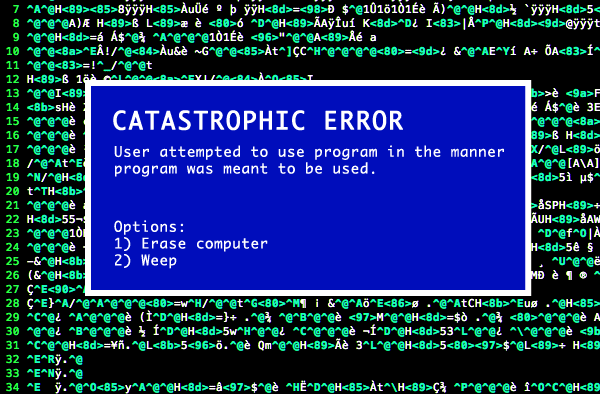
Catastrophic error: User attempted to use program in the manner program was meant to be used. Options 1) Erase computer 2) Weep

Doing Terrible Things To Your Code

In 1992, I thought I was the best programmer in the world. In my defense, I had just graduated from college, this was pre-Internet, and I lived in Boulder, Colorado working in small business jobs where I was lucky to even hear about other programmers much less meet them. I

By Jeff Atwood ·
Comments

Recent Posts

map of the United States via rgmii.org showing all 3,143 counties by rural (gold) / metro (grey) and population

Launching The Rural Guaranteed Minimum Income Initiative

It's been a year since I invited Americans to join us in a pledge to Share the American Dream: 1. Support organizations you feel are effectively helping those most in need across America right now. 2. Within the next five years, also contribute public dedications of time or

By Jeff Atwood ·
Comments
Let's Talk About The American Dream

Let's Talk About The American Dream

A few months ago I wrote about what it means to stay gold — to hold on to the best parts of ourselves, our communities, and the American Dream itself. But staying gold isn’t passive. It takes work. It takes action. It takes hard conversations that ask us to confront

By Jeff Atwood ·
Comments
Stay Gold, America

Stay Gold, America

We are at an unprecedented point in American history, and I'm concerned we may lose sight of the American Dream.

By Jeff Atwood ·
Comments
I’m feeling unlucky... 🎲   See All Posts